How Amazon Bee Works: From Microphone to Summary, Step by Step
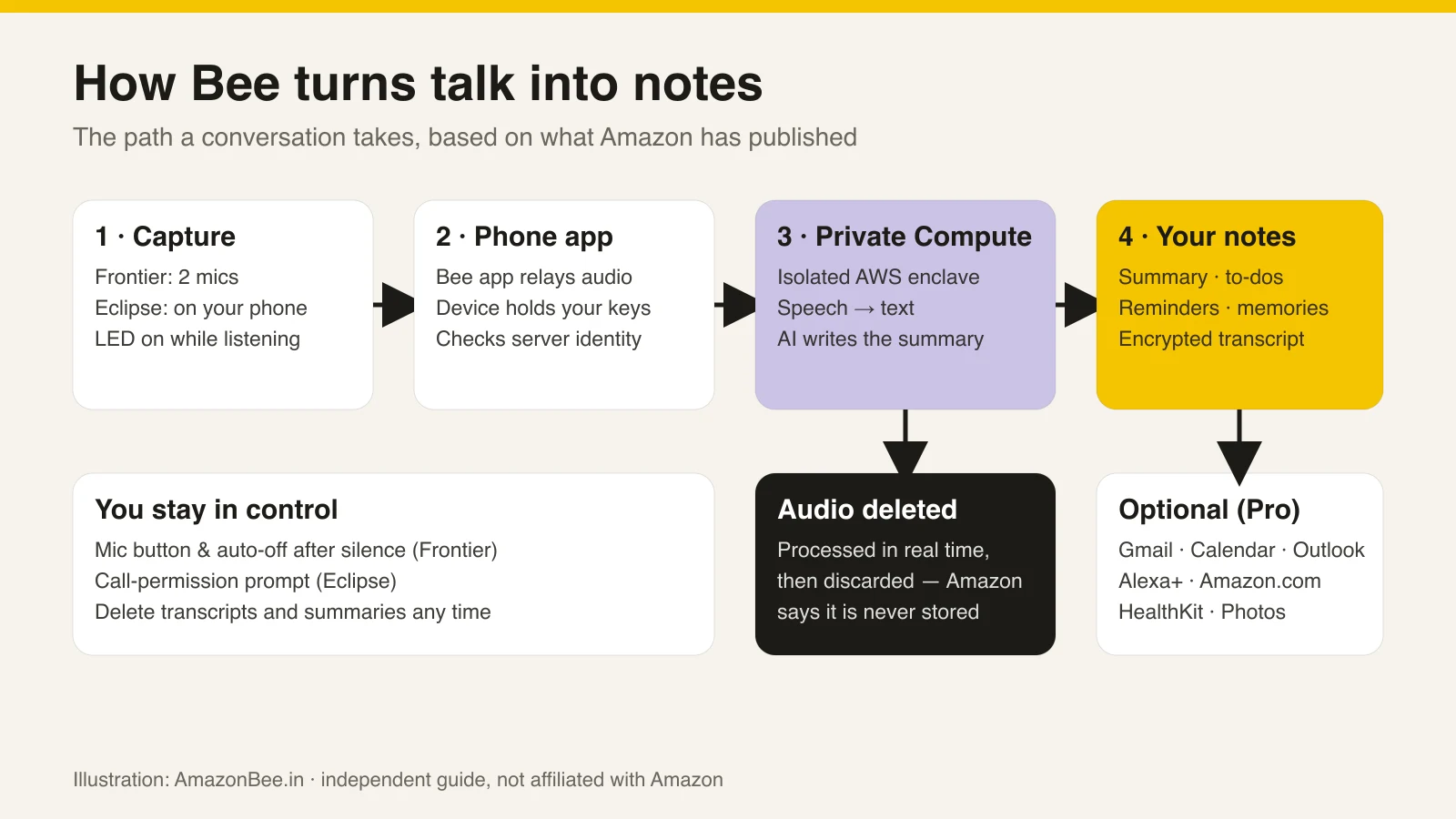
A Bee device is mostly microphones, a battery and a radio. The intelligence lives elsewhere. Here is the journey of one conversation, based on what Amazon has published — and where its descriptions stop.
1. Capture
When you press the microphone button, the device starts listening and its indicator light comes on. Frontier uses two microphones and Eclipse reportedly three. Several microphones let software do beamforming — favouring sound from the direction of speech and suppressing clatter, air-conditioning and background chatter. On Frontier you can set auto-off after 5 or 15 minutes of silence.
2. Through your phone
The device pairs with the Bee app on your phone, which relays audio onward. Amazon's privacy description adds two important steps here:
- your device generates and holds the encryption keys used to protect your transcripts, and
- before sending anything, it checks that the server is running approved software (known as attestation).
3. Bee Private Compute
Processing happens in the cloud, inside what Amazon calls Bee Private Compute — an isolated environment built on the AWS Nitro System. Amazon's technical paper says data is encrypted before it leaves the device and decrypted only inside attested confidential virtual machines.
Two AI jobs happen here:
- Speech-to-text. The audio becomes a transcript, ideally with different speakers separated (diarisation).
- Language-model processing. A large language model reads the transcript and produces a summary, to-dos, reminders, "facts" about your life, and themes over time.
Amazon has not said which speech or language models Bee uses.
4. Audio is deleted
Amazon's central privacy claim: audio is processed into insights in real time and then deleted. No recording is kept. What survives is text — the transcript and the notes — encrypted with your keys.
This has a practical consequence few launch stories mention: you cannot go back and listen. If the transcript misheard a name or a number, there is no audio to check. For interviews or legal work, that matters.
5. Your notes, and where they can go
You read results in the phone app or, with Bee Pro, the desktop app. If you opt in, Pro can push information to Gmail, Google Calendar, Outlook, Apple HealthKit, Photos, Alexa+ and Amazon.com. Each link is optional, and Amazon says you can stop sharing at any time.
Why not do it all on the device?
Running high-quality speech recognition and a capable language model needs far more power than a week-long-battery wristband has. Phones are getting there, but Bee chose the cloud and built Private Compute to make that more trustworthy. The trade-off: Bee needs a connection, and you are trusting Amazon's hardware isolation rather than keeping data physically in your pocket.
Next: Bee Private Compute explained.
Sources: Amazon: Introducing Bee Frontier and Bee Eclipse · Amazon: Bee Private Compute · Amazon Science: Bee Private Compute paper · Engadget launch report. Specifications are as published at launch (15 October 2026) and may change. AmazonBee.in is an independent site and is not affiliated with Amazon.